We began with these simple elements:
- A desire to see Dolores Hidalgo and San Miguel as places of beauty and historical importance to Mexico,
- also given the constant raging at Tripadvisor about which is best, Guanajuato or San Miguel...

- Our decision to stay in this magical Casa Azul in Guanjuato, but needing to see what was just over there in San Miguel.
- The warm recommendation from hosts and previous guests that we use the services of Israel Torres as guide for such a trip.
- Just one day.
- So we rang Israel and in the course of a day found a friend, an intellectual resource, a fount of local knowledge, finder of special things and places.
 |
| Helen's photo |
We have always avoided using guides, preferring our own discoveries, not being force-fed. But we could not have achieved what we did or learned what we did in our day without Israel. I was exhausted. Israel, always a gentleman was tired after over 10 hours driving, translating and guiding. Helen did the keep-talking-to driver-on-way-home.
I said "over 10 hours". Out at 9, back around 7.30pm.
Ms Google has taken off her San Francisco running shoes and donned her fantasy cap in the time suggested on this map.

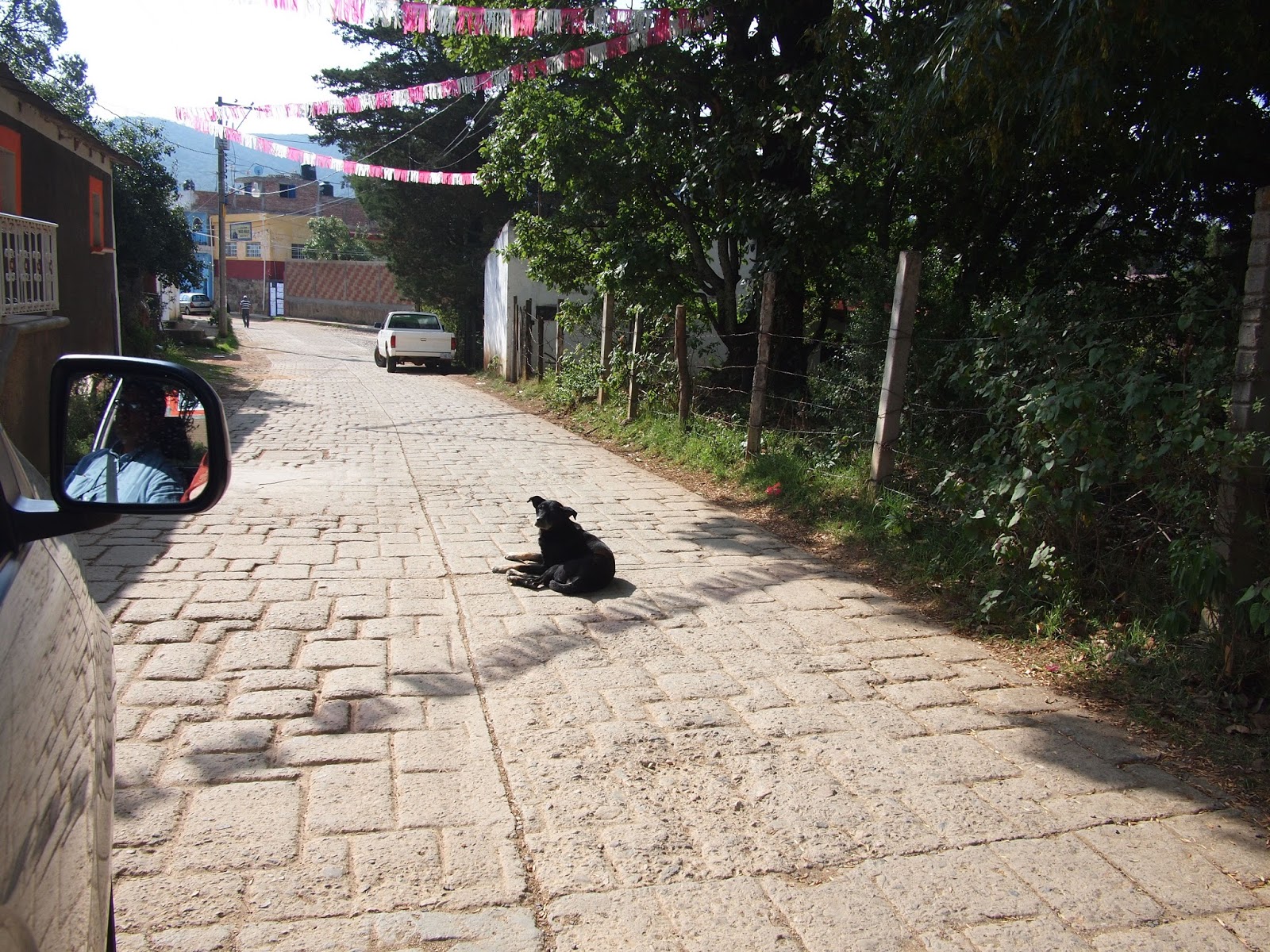 |
| "It is his road. I think we have to go around." He did not move. |
We said to Israel that we would like to have a coffee in some place early to discuss what we wanted to do.
 He took us to a good place at the tiny pueblo of Santa Rosa that was not really open at that hour but open to him.
We said we knew the general history of Dolores Hidalgo and San Miguel and wanted to see the iconico. That we wanted to photograph nature, places, people and detail. That we wanted to eat well and where he would like to eat.
 |
| Helen's photo |
It was also for this that Israel had brought us to Santa Rosa, where a women's cooperative with some government support progressively as they succeeded had established a ceramics business with (as we would be told) fourteen artists.
We could not photograph inside for reasons of protecting intellectual property. We can say we found their work equal to any elsewhere, better than most. And we talked with them.
Dolores Hidalgo was the town of Dolores until after the historic first blow for the independence of Mexico in 1810. The 'Hidalgo' is the surname of the local priest Miguel Hidalgo, who had been asked to come from a smaller village to this church when his brother, the former priest, had died. He was a criolo, a term explained by Israel: a Spaniard but born not in Spain but Mexico, born to second-class citizen status. Hidalgo had been studying in school with the Jesuits when they were expelled from Mexico and the catholic world generally in 1767, a huge shock to Mexicans. Wikipedia says he got the nickname Zorro (the fox) at school, for his cleverness. The wikipedia account of his life as a man of the enlightenment, opening his house to all classes, in unions libres with two women, fathering five children and engaged in scientific studies is a good read. The Inquisition called him in from a more senior Church post to review his life and sacked him from there and sent him to the lesser church outside Dolores. No harsher treatment, perhaps not enough priests if they went down the road sacking the naughty. The Crime of Padre Amaro explores such issues in more modern times.
There is an excellent account in Lynn Foster's A Brief History of Mexico of Hidalgo's involvement with a secret group in Queretaro reading and studying enlightenment history and contemplating what was to be done. Spain was by 1810 under Bonapartist rule, Spanish rulers in Mexico incensed by liberal ideas introduced in Spain. The Corregidor (authority over the mayor) in Queretaro began rounding up the group, having locked in her room his wife Doña Josefa Ortiz de Dominguez, a member of the group, who nonetheless got word out to the mayor who got word to Hidalgo, who got word to another member of the group, Captain Ignacio Allende in San Miguel, that they must act swiftly before being rounded up.
And so it was that at the astonishing hour of 5.30am on 16 September 1810, the bells rang out in little Dolores, people came running and Hidalgo, flanked by Allende and others, cried out the Grito de Dolores: the Shout for Independence. The wikipedia entry at that link nicely explores the uncertainty over what he said then, the pre-dawn rush, the sanctification of the words in the annual words of modern presidents on this national day.
Here follow us to the towns which have taken the names of these heroes.
 |
| Where Guanajuato, the capital of the state of Guanajuato is of fabled beauty because it is in a valley, you climb over a range of hills onto a vast plateau of fertile country around Dolores and San Miguel. |
 |
| Monday a nice day to travel, back to school, back to work, chance to read the posted declaration of the poll in yesterday's elections in this school. |

 |
| Here is the famous church, with its churriguerresco (Mexican baroque) front. Photos I had seen seemed awkward, it's like a thumb in space. It is difficult to capture the way it stands alone in this square. I had difficulty getting a good photo. I did not get a photo of the large bronze head-sculpture of the hero Doña Josefa Ortiz, but if you go to where I took this photo and turn right you will see her. |
We have absorbed some molecules of the moment.

 |
| Here the interior. |
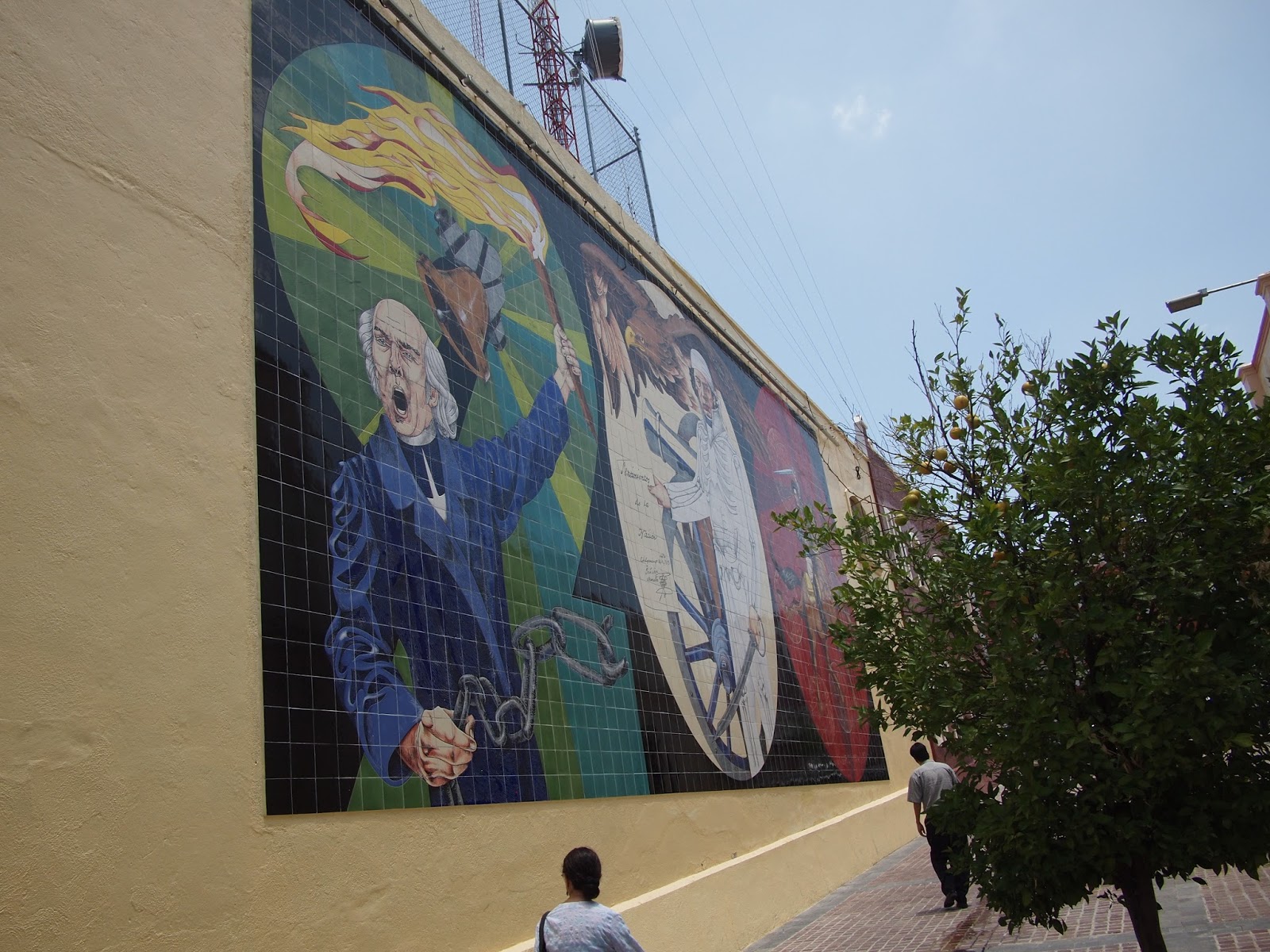 |
| and here on the wall of a building alongside, the hero priest, beside him his successor in revolution Morelos, whom we introduced here |
 |
| and in the museum the bell |

Just along the street, another poll declaration
 |
| and in the park a tree grown from a seed of the tree under which, in the Alameda in Mexico City, the conquistador Cortes wept on the Noche Triste |
En route from Dolores to San Miguel, we diverted to the town of Atotonilco.

where Helen called us to a halt
 |
 |
to visit this lady, whom she had seen working, in front of her display of beautiful family textile work |
 |
| an especial charm on the outside does not prepare one for the inside |

The sanctuary has acquired the descriptor "the Sistine Chapel of America" but it is not derivative, it is its own magical self.
Israel proudly and warmly told us how the painting was done by an indigenous Mexican from Queretaro in the mid-1700s, an artist with no direct knowledge of European art, informed by some illustrated books. The style is assertive, the gospels are told vividly in a procession of panels and in a gigantic of scenes above the altar.


You could spend a long time admiring and studying
and if a believer immersed in teachings.
A sanctuary....
but we had to head on, the day progressing...
San Miguel de Allende
The San Miguel is St Michael Archangel.
The 'de Allende' is in honour of Ignacio Allende, of whom some mention above, the military officer who wanted no longer to oppress and who might have led the day in 1810 but for the message getting to the priest Hidalgo first and Hidalgo rousing the crowd and leading them towards Guanajuato with the mystical power associated with bringing along La Nuestra Señora de Guadalupe.
I look up from this laptop in Guanajuato and see the corner of the Alhondiga which they sacked and I see the name ALLENDE on the corner of the building where Allende's head was posted on a stake after the rebellion was crushed.
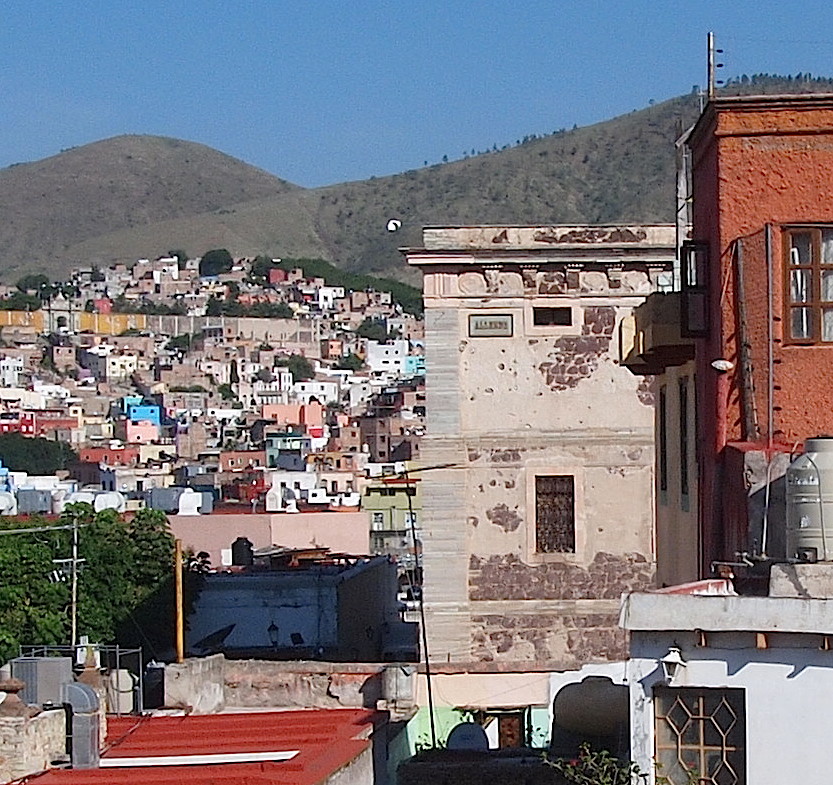
San Miguel de Allende is a very different town from Guanajuato. Out on an undulating plane, amidst agriculture, it grew as a place where genteel people might spend time en route from Mexico City and Queretaro towards Guanajuato and beyond. A place where the products of gold and silver mines were coming south and products from Europe heading north. A place that was built with refinement, with streets orderly.
In more recent times, its fame and settlement related to the arts. Cossio del Pomar found it sleepy in the 1930s and began establishing the arts there. Especially in the wake of World War II after which U.S. servicemen could use their GI Bill entitlement to study abroad, interesting people came here to study art. Then later alternative generations, then affluent travellers and settlers from the USA, so where Guanajuato is a place mainly of Mexican life, San Miguel has some international flavour in the people walking the streets and the content of shops. At the same time, perhaps drawn by exotic money, there are a lot more people of diverse Mexican cultural and ethnic background walking about and offering wares. We ate in a nice Mexican restaurant but surrounded by lunching women of U.S. origin. A travel magazine article with more of this is here.
It's also a bit hotter there on the plane. The valley in Guanajuato contains shade and draws convection currents during the day. So in answer to the often asked question, which place to stay? We are pleased to be in Guanajuato for many reasons, but can see that San Miguel is a very special place... requiring considerable mental adjustment to see in its own right.


 |
| a little toast to Helen's daughter this day graduating with high distinction results in Sydney |


 |
| the formal photography |
 |
| the informal photography |
 |
| St Michael the Archangel is up there |

 |
| We saw flashing police lights ahead as we drove out of town. They were organising a happy march. |
 |
| I swear the music from the sound system was the Mickey Mouse Club theme song in Spanish, mutated over decades as these Mickey Mice seem to have done. |

 |
| and home past vast field of mais |
THE LAST WORD.
Helen says: "It was interesting over there but Guanajuato makes our hearts sing."