Tuesday, 26 May 2015

to arrive in beauty

The flight we took to Mexico City was ideal. A 737-800 with lots of spare seats, departing on time at 11.15pm, clocks forward two hours, quick snooze, arrive half an hour before 5.25 ETA, bags by 5.30, on Metrobus Linea 4 Norte zooming down fairly empty streets in its exclusive lanes with only four passengers by 5.50, by 6.30 walking the pre-dawn through the park past the magical Palacio de Bellas Artes and into the no-cars Avenida Francisco Madero named after the first President.

After two short blocks, turn into Calle Bolivar, named (I think) for the most renowned independentista of the western hemisphere, Simon Bolivar, open the big front door opposite Dolce e Gabbana into this our courtyard.


and arriving at our front door in the Casa Borda this is the view back


and inside our airbnb studio apartment, our host's style makes for great comfort... and it's actually more intimate and warm that the cool elegance displayed at airbnb.


I went out for breakfast things to where the world was scrubbing up


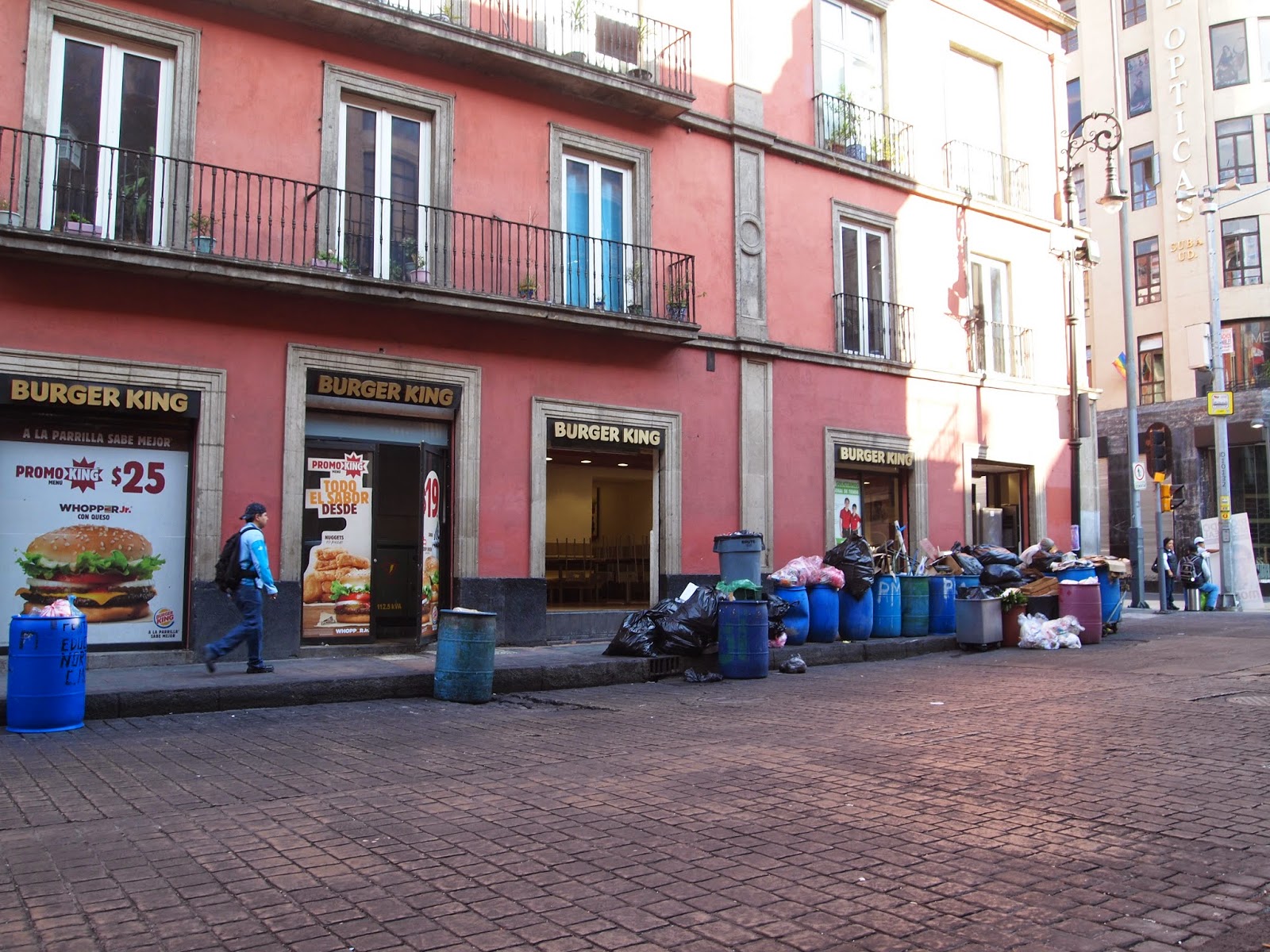
past the no-such-intense-sanitisation outside the junk food on the corner


and around into Madero, with all its history now overseen by the Torre Latinoamericano


It's a gentle place to sweep into, although abundant police presence.

I had a muy rapido conversation with the smiling man in the Aero shirt as he flew by.
Welcome to Mexico! 
Gracias señor!


Google has responded, providing responses in Spanish now, to all this magical sliding into a nuevo mundo... which is how it feels. There is a rhythm that just is, even if it's not always the same rhythm, it rhythms. I have to go back at 6.30 another morning to capture not only the haunting Bellas Artes in its pre-dawn silence but also the row of slightly nervous (or jumpy-tired from night shift?) young police with shields protecting the end of Madero.

I asked the jefe:
Esto es normal, o es un problema, senor?
Es normal senor
Whether that's good Spanish I'm not sure, but it's what was said. You have to dive in. And I have to find out how to do the Spanish style of placing a question mark at both ends of the question, the first one inverted. And how to put the wavy over the n in senor. This is going to be packed with questions, senors, senoras and senoritas! Ai yai yai!

I stood on the corner of Madero and Bolivar at 9am to make this tiny (and trembly tiredy) movie.


Sunday, 24 May 2015

arriving Tuesday

We are in San Francisco, this has been the last two weeks of blog of Seattle to San Francisco.

We take the overnight flight from San Francisco to Mexico City Monday night, arriving very early Tuesday.

I was very pleased with myself with my first Latin Spanish conversation today, at the Arguello Market.

In English–I dare not try to write it in Spanish–it ended like this:

"I am very happy. This is my first conversation in Mexican Spanish."

"That's very nice."

"Where are you from in Mexico."

"I am from Honduras."

:-)

Thursday, 26 March 2015

Pinteresting

I was slow in discovering Pinterest, I suppose, but I have realised in a few weeks its value in enabling assembly of images and notes in a new kind of research. I have observed that some people, most people, seem to engage in detailed taxonomy, dividing information into compartments, mainly practical information for the kitchen or garden, as well as art and travel. In a few weeks I have surprised myself, eventually setting up or joining 12 'boards', subjects for information, though the core of my mind's assemblage is in fewer than that. And in my assembly, the boundaries between groups seem unclear, as they do in my head.

It's valuable, it's a trip to Mexico in itself.

Here is my Pinterest page. It contains cultural and colour glimpses and identifies places to go, ways to see and things to eat, etc.

Wednesday, 4 February 2015

in memoriam: Rochelle Cashdan, Guanajuato blogger

Great value in research before travel!

I've discovered that there is a host of blogger participants in Guanajuato. The first I came across and the most rewarding so far is that of Rochelle Cashdan who brings to the task an air of cheeky maturity and a perception of the world with which I feel comfortable (she is an anthropologist gone to writing, where I am anthropology-trained, but variously gone to seed) and a readiness to provide through her blog very current interesting news of events in Guanajuato.

Also a link to read the blog of Benjamin Arredondo wherein interesting social and historical commentary and a wealth of information.

11 June 2015: We wrote to Rochelle to say we would love to lunch, but no reply. Later have just learned that Rochelle died shortly before our arrival in Guanajuato following surgery in the USA.

Rochelle remains, with her smile, with her evident intelligent, warm curiosity for life, an exemplar of what we hoped to find and what we did find in Guanajuato. And on the evidence of her blog, we think she found good life in Guanajuato. Thank you Rochelle.

Wednesday, 28 January 2015

Flash mob

I have not been aware of the idea of 'flash mobs' which seems to be a decade old. Mexico is a singing and playing place where it seems popular. Here is a very elegant flashmob performance on the corner of the street where we will stay in Mexico City.


Monday, 26 January 2015

Ya me canse

The expression Ya Me Canse entered the vocabulary of protest in Mexico when these words, meaning "I've had enough" were uttered by the Attorney General of Mexico, after wearying of answering media questions about the murderous disappearance of forty three rural poor student teachers in September 2014.


The students had, according to a tradition, taken two local buses to ride to a protest event in Mexico City, commemorating a 1968 massacre by government of students before the Mexico City Olympic Games. Here speaks a survivor of what happened to these students in September.


Ya me canse
 was taken up as a cry by wider population, fed up with murders and evidence of state involvement in them in many places, or arising from the state's war on narco gangs.

Francisco Goldman's articles in the New Yorker provide useful independent insight.
Mexico’s rural teachers colleges have a long tradition of leftist activism, but this would be the first “actividad de lucha” for most of these youths. They were to block a highway to solicit travel funds for the annual October 2nd march in Mexico City, which commemorates the 1968 massacre of student protestors in the Tlatelolco Plaza by the Partido Revolucionario Institucional (PRI) government of Díaz Ordaz. In keeping with protest traditions, they would temporarily commandeer busses from private bus lines for the trip to Mexico City.
That Friday, the students left in two busses, but needed two more, which is how they ended up in the small city of Iguala. They didn’t know that the politically ambitious wife of Iguala’s mayor, José Luis Abarca, was giving a speech that evening. They also didn’t know that her brother, known as “El Molón,” was reputedly a leader of the narco-trafficking gang Guerreros Unidos, which, with the mayor, ruled over Iguala.
Francisco Goldman, "Crisis in Mexico: The Disappearance of the FortyThree", New YorkerOCTOBER 24, 2014

There is now a website yamecanse.mx with a short video introduction.


We have no intention of involving ourselves in Mexican politics, but we visit Mexico acutely aware of the pain of the killing of many tens of thousands of innocent people in the last decade or so. We will go to places deemed safe, much safer than many cities in the United States.. but aware of the need to skirt around troubles. Aware that ordinary Mexicans mostly do not have the luxury to absent themselves from dangers. Aware of the courage of those who take a stand against the present situation.

The picture postcard is a delight, as I discover the value of pinterest for assembling information. But we do not want to wander through the tourists' postcard world unaware.

For those filled with the sporadic wild international media reporting of demonstrations in Mexico City about this here is a real account of a 'flash mob' demonstration in the Zocalo, the central square in Mexico, second largest public urban square in the world after Red Square, paved with stones that Cortes acquired by tearing down the Aztec Palace that stood there.


Friday, 14 November 2014

Where we will go

We have a preference for staying rather than running, for being among people more than looking in, for eating as locals rather than being waited on.

In Mexico City we will be right at the centre in this apartment rented via Airbnb - for a week. The apartment is in the Casa Borda, originally built by José de la Borda in the 1750s as a gift for his wife.

----

Then by bus to Guanajuato, a city with a history of fabled wealth, at the end of the 1500s producing 60% of the world's silver. There we will stay in this place rented via VRBO for nine nights.

We had never heard of Guanajuato, but it now beckons...